


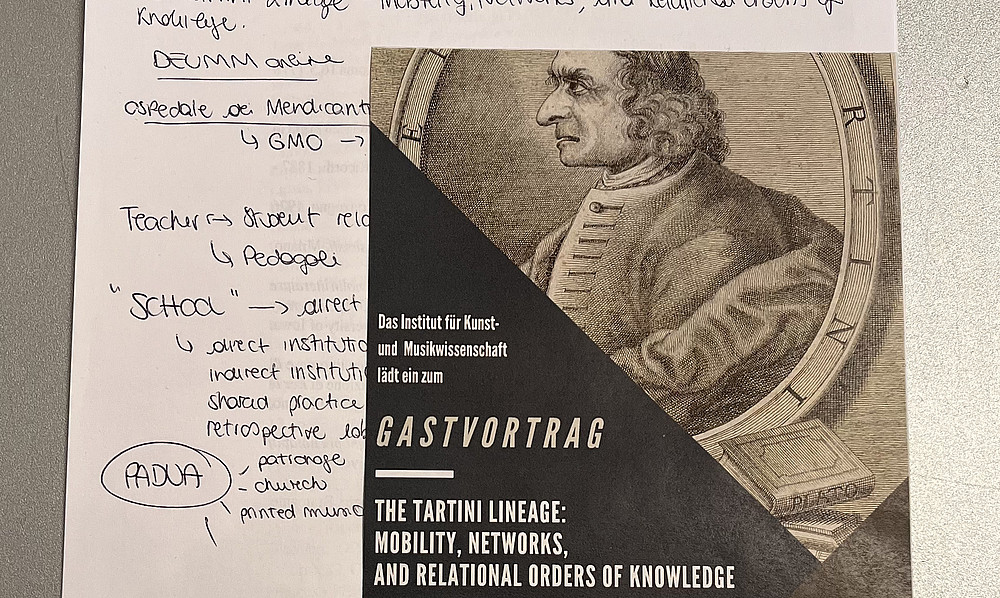
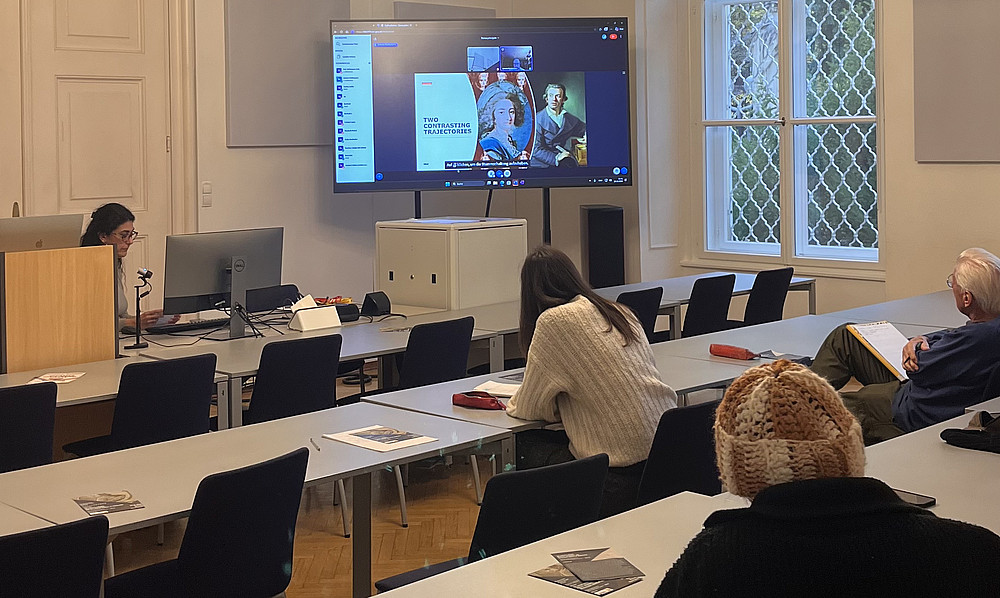
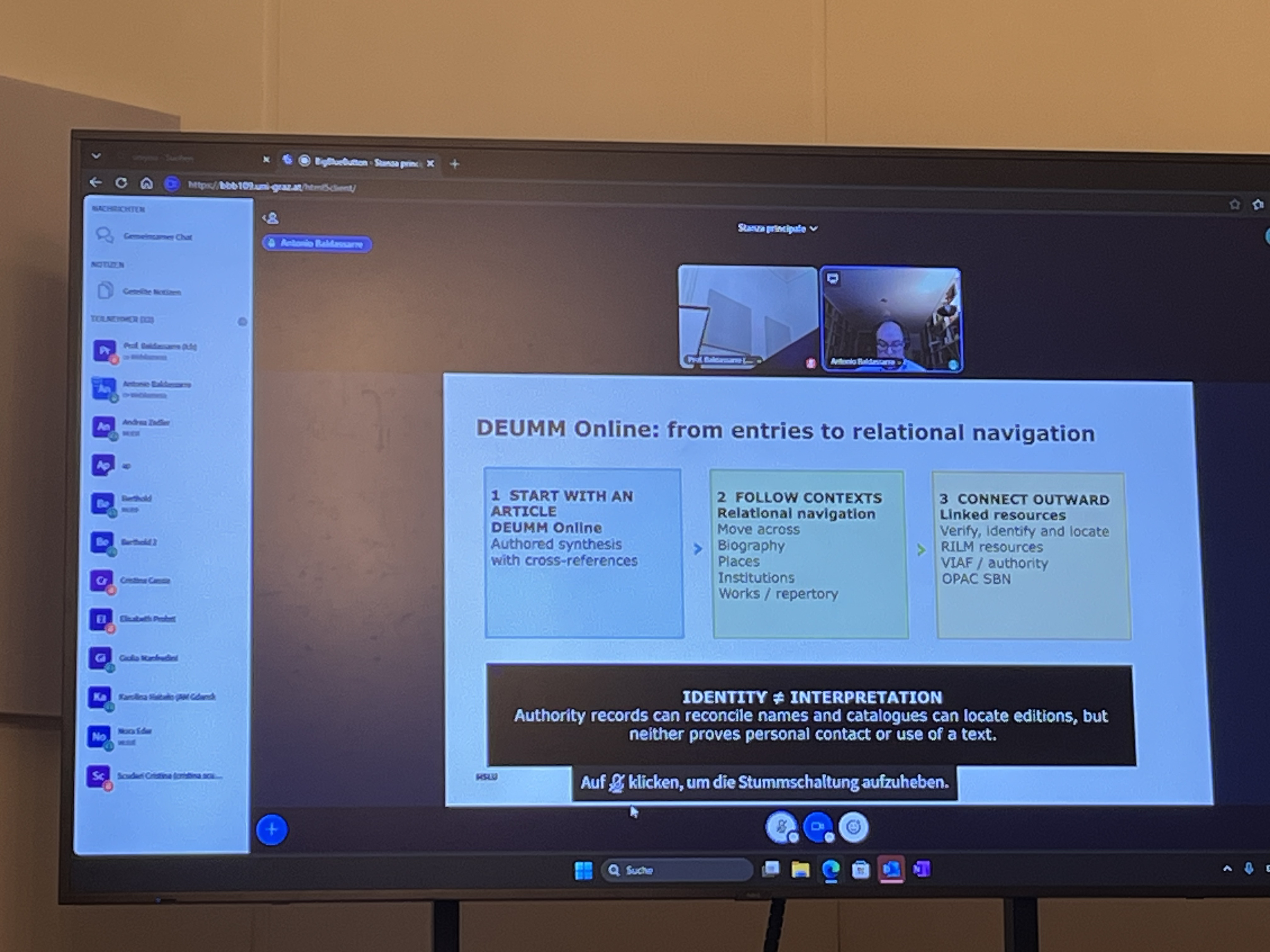
On Thursday, 29 October 2026, Prof. Antonio Baldassarre (HSLU Hochschule Luzern) gave a lecture as part of Prof. Cristina Scuderi’s course at the Department of Musicology of the University of Graz (Mozartgasse 3). The lecture was titled The Tartini Lineage: Mobility, Networks, and Relational Orders of Knowledge.
Baldassarre presented the idea of a “Tartini lineage” not as a self-evident historical object, but as a methodological problem. How can relations of teaching, imitation, correspondence, travel, institutional affiliation, and print circulation be described without reducing them to a linear genealogy? A musician might have studied directly with Tartini, met him only briefly, learned from one of his pupils, spread elements of his technique elsewhere, or been linked to him only through later processes of attribution. These connections differ in duration, intensity, direction, and historical visibility, and the challenge is to develop forms of representation that preserve these differences.
From this perspective, DEUMM Online, the digital edition of the Dizionario Enciclopedico Universale della Musica e dei Musicisti, takes on particular relevance. Thanks to its node-based technology, it is more than a lexicographical repository: it connects persons, places, institutions, sources, and forms of transmission within a relational structure. The Tartini lineage can thus be represented as a constellation of differently constituted connections, and mobility becomes an organizing principle of knowledge rather than something to be reduced in order to achieve historical coherence.
Methodologically, the lecture brought together prosopography, source-critical network analysis, and the relational possibilities of DEUMM Online. The Tartini case serves as a testing ground for a broader question: how can music history build relational orders of knowledge that make movement, mediation, and multiple forms of connection visible, without translating them back into a single genealogical narrative?